

July Week 4: The Pastorale

Today I took a very lengthy trip for one of the flagships of my project, the Pastorale, the classical example of Total Theatre originating in the tiny mountain villages of the Pyrenees.

It was difficult to make it to the tiny town of Libarrenx. After a two hour train, and two hour bus into the countryside, I arrived at my hostel the only available accommodation within two hours of Musculdy, the site of the Pastorale. I arrived early and was delighted to learn there was an alternative theatre festival occurring in this village called Izakiak. Izakiak described itself as a conglomeration of dance, song, painting, and traditional music created by the people of this village each year to celebrate being alive in the Pyrenees. What a perfect example of Total Theatre!
The performance was held in the public park behind the Chateau. Overlooking the River, I arrived just in time for the opening scene, where a reciter read the myth of the Lamiak, the wild mermaid-like character of the Basque Country, in the Basque language. Seemingly out of the water, began to creep out a woman dressed in leaves and hair down to the floor. She contorted her body to the sounds of the Basque wind instruments. As she leapt onto the land and began to share space with us audience, the bounds between performance and interpersonal connections melted. She interlaced herself between the field where we sat, reacting to the audience, stealing hats, and making us realize the boundary between folktale and real life were not as far off as they seemed. Other acts followed in the park as we, the audience, musicians, and actors, walked from each site to the next together. As night began to set the actors pulled out chairs, and invited the audience to sit directly outside the chateau where for the first time, the musicians began to speak, and then played a very typical, Mikel Laboa-esque, Basque angsty rhythmic improvisation. The musician told me that the trees demanded he play it once a year, and that he had done so, for the last 50, to thank the land for his farm, his family, and his rhythm. It was a beautiful performance, and an amazing thing to see such community support in this tiny village for this non-commercialized, non-advertised event, that just so happen to occur whilst I was there.


The next morning I caught a lucky break. Of the many rooms in the chateau only two were occupied, one by myself, and one by a family that included the lead camera people for the Pastorale event. They happened to sign up at the last minute for the breakfast that morning and were of course seated right next to me. They were kind enough to offer me a ride to the event, saving me a three-hour bike ride at 7 in the morning. It would prove well worth it, as they knew the festival well, and I got to experience everything with front row seats, able to participate to the fullest of levels.
This part of the French Basque Country, known as Soule/Xiberoa, consisted of many little villages, around 200 people each, dotting various sides of the valley just beside the Pyrenees. Musculdy was a village, quite similar to its sister villages, except this year it was given the great honor of putting on the Pastorale. Each year, a different village is given the honor of putting on the Pastorale. The people of all the neighboring villages will then come to visit. It is competitive, with each village enlisting a local to create a play, and should the town be selected, there is only a pool of 200 people or so available to cast and mount the production—the townsfolk. Clearly, it has been a successful effort as it has lasted without stopping for centuries, and this year would be no different.
It began with the same traditions, everyone would gather in the church, a tiny stone building, overflowing with people as the town population nearly tripled. The wooden aisles shook as people crammed into the building like sardines. For the songs of the mast, actors would be called up in costume. They likely doubled as choir members during the rest of the year too, but today was certainly special. After the service, we emptied into the one street town to watch the procession of the actors as per tradition. Now what was unique this year was the theme of the Pastorale. Traditionally, Pastorale had been only male performers, up until the 1990swhen female identifying people were first allowed to perform. The types of stories presented changed too, to showcase female characters performed by female identifying people. All shows deal with the battle of good vs evil and often featured big-name heroes of French, Spanish, or Basque origins, battling it out in the ultimate battle of blue vs red (the blue representing the heroes, the red the villains). This year, the town decided to showcase the story of Simone Veil, Holocaust Survivor and French Hero of Women’s rights. The costumed procession began down the cobblestone road, and we saw Simone, followed closely behind by flower power dressed feminists, and behind them the row of red, performers dressed as Nazi. After these new styled costumed characters, came the traditionally, a herd of 40 sheep followed by shepherds. Regardless of the alteration of themes, to be a Pastorale, the pastoral lifestyle must be showcased and as they appeared I followed closely behind this merry band as they overleapt the paved roads into dirt trails canvasing the rolling meadows of the countryside and into the arena.


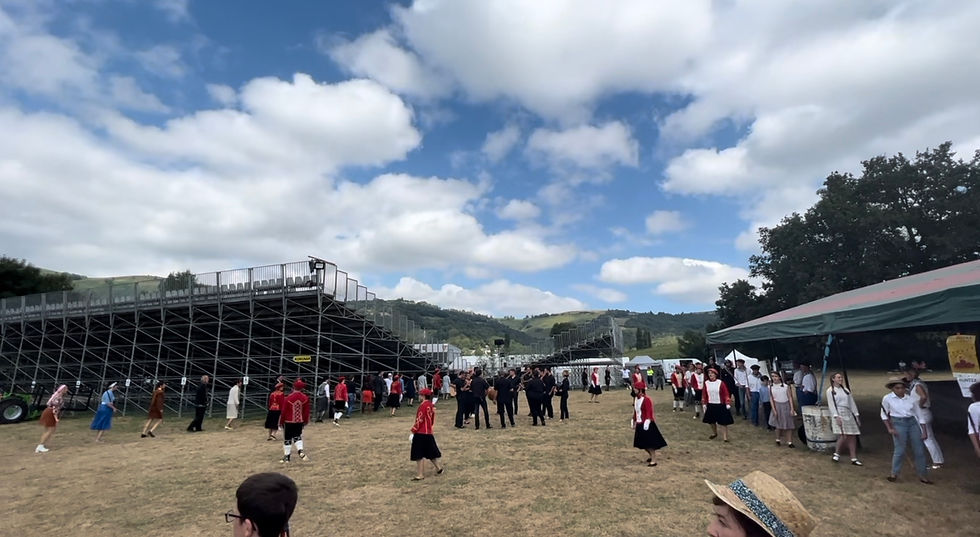
The festival would last all day, well into the darkness of the night (how lucky was I to have a ride back to the hostel!). After a series of meals, the play began, lasting over four hours without intermission in a large, purpose-built amphitheater with metal bleachers at times directly facing the sun. The Façade of the outdoor stage consisted of a blue door on stage right and a red door on stage left. The stage was bare. As the action began to unfold, everything became ceremonial, the traditional start saw the characters in blue exiting their door with canes (think shepherd’s crooks) and the red team making a similar exit. They’d face each other, raise their canes, salute the audience, and return to their doors. Then the action began. The characters would enter one at a time, parade along the square of the stage so each side of the audience could see their whole being, before returning to the middle, stamping their cane, reciting Basque rhymed verse, and continuing to walk the circle. The level of tone varied by character, many maintains a monotone throughout, other’s recognizing keen emphasis. The star of the show, who played Simone, was certainly talented, and during the moments when song broke through, her voice carried far beyond the stacked amphitheater surrounding her. Whilst classical in ideals, there were many modern jokes and clever word play inserted in the text. The audience, predominantly Basque or French speaking were following along the whole show. Even as the sun set, many of us refused to leave our seats. When some did, they would stretch and head for a head as if it was the seventh inning. This activity did not offend the actors performing, or interrupt the performance, but the celebratory attitude kept the faith of the event, community centered and fancy free. With the given nature of an outdoor performance in a tightknit village with an audience of mostly local community members (I was without a doubt the only American, and non-French-Basque-born person there), certainly there was a comfortability in the audience-cast relations. After the show in fact, as the cast got out of costume, many would join the audience for a drink at the festival bar. Some would rush even faster, and by the time I made it to the street food parlor, I noticed many of the former performers were now serving me, just minutes after the performance’s end.


It is a theatre which is all encapsulating, not merely in the nature of the performance, but in how it includes each aspect of the lives of this community. Every person is called to serve, from grandparents to nieces, cousins to uncles, all families were included in some capacity to put on this production, behind stage, on stage, or at the side handing out water bottles to thirsty audience members on a very sunny day. After a complete year of preparation, this was the reward, a united day of community across the region. A day of story passing, and of sharing space in a common language on a shared day of remembrance. It was a beautiful thing to witness, and as I drifted to bed that night in my tiny hostel room, I imagined in what ways a similarly unifying style of festival could grow out of my community at home. Would it be possible?


Comments